You want to visit Poland for a short stay, but cannot decide which city to visit? Both keep appearing on every best-of-Poland list. Both are affordable, walkable and packed with history. Which one actually deserves your time?
This guide breaks it all down, category by category, with a clear verdict at the end. And if you have enough days, we’ll tell you how to fit in both.
Summary: Both cities rank among the finest destinations in Poland, but they suit very different trips. Kraków, located in southern Poland, is the cultural heartland: a royal capital with a UNESCO world heritage Old Town, a hilltop royal fortress and easy day trips.
Gdańsk is a Baltic port in the North with a rebuilt Hanseatic historic centre, a compelling WWII museum and beaches on the doorstep. For first-time visitors, the South is the safer bet. For something coastal, less crowded and equally beautiful, the North wins.
Article prepared by Luggage24 – automatic, convenient luggage storage in Warsaw, Kraków, and Gdańsk.
- Krakow vs Gdansk: The Key Differences at a Glance
- Poland's Royal South: History and Architecture in Kraków
- Poland's Baltic North: The Rebuilt City of Gdańsk
- Which Polish City Has Better Food and Nightlife?
- Beaches, Day Trips and Outdoor Options
- Crowds and the Tourist Experience
- Getting There and Getting Around
- Should You Visit Both Cities?
- The Verdict: Gdansk or Krakow?
- Frequently Asked Questions
Krakow vs Gdansk: The Key Differences at a Glance
Kraków is Poland’s former royal capital, sitting inland in the south on the Vistula River. Its medieval market square and surrounding streets form a listed historic centre, and the palatial Wawel Castle looms over everything from a limestone hill. It’s a city that has survived centuries largely intact, which makes it exceptional.
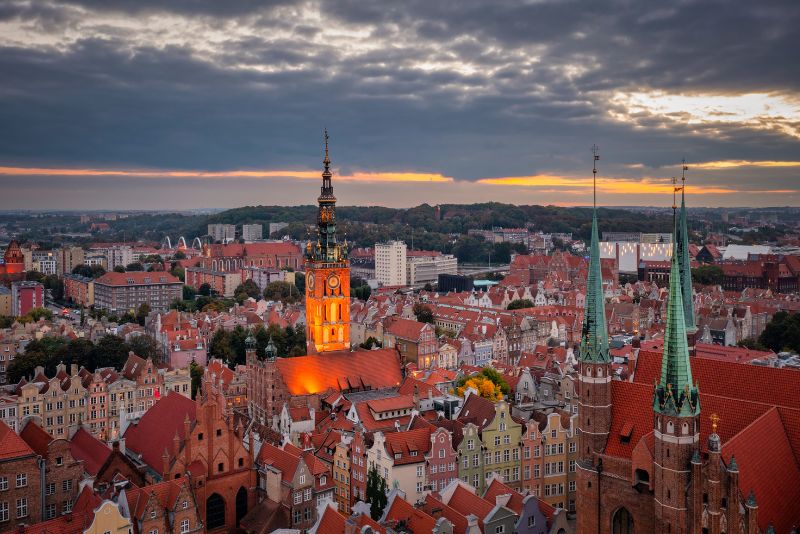
Gdańsk sits on the northern shore of Poland where the Motlawa river meets the sea. It’s the largest of the Three Cities region, alongside two sister cities to the north. Almost completely destroyed in 1945, the reconstruction was completed over the following decades and is now one of the most striking seaside old towns in Central Europe. It’s also the birthplace of Solidarity, the trade union movement that helped end communist rule in the region.
Both cities have grown sharply in recent years. Kraków received 14.72 million visitors in 2024 (Polish language source) — nearly double the 8.4 million recorded in 2022 and approaching the pre-pandemic record of 14 million set in 2019. British visitors make up the largest share of international arrivals (20.6%), followed by Germans and Italians. Gdańsk reached a record 4.1 million visitors in 2023 (Polish language source), up from 3.7 million in 2022 and 3.5 million before the pandemic. The gap in scale is significant — Kraków attracts roughly three and a half times more visitors — but Gdańsk’s growth rate has been faster in proportional terms, and the city consistently scores 8.6/10 in visitor satisfaction surveys.
Here’s how both compare across the criteria that matter most for a city break:
|
Category
|
Krakow
|
Gdansk
|
|---|---|---|
|
Location |
Inland, south |
Northern coast |
|
History focus |
Royal heritage, historic quarter, Jewish district |
WWII, trade union history, maritime |
|
Beach access |
No |
Yes (15 min by train) |
|
UNESCO status |
Historic centre and Nowa Huta district listed |
Not listed |
|
Crowds |
High in summer, sustained year-round |
Sharp peak in July–August, quieter otherwise |
|
Best day trips |
Auschwitz, Wieliczka, Zakopane (mountains) |
Malbork fortress, Hel Peninsula |
|
Evening scene |
Student city, lively bars |
Craft beer, relaxed |
|
City size |
Second-largest city in Poland |
Mid-size, easy to walk |
|
Recommended stay |
3 nights |
2 to 3 nights |
Poland's Royal South: History and Architecture in Kraków
Few cities in Poland reward slow walking the way Kraków does. The market square at the heart of the historic core is among the largest in Europe. The Cloth Hall bisects it, the Gothic spires of St Mary’s Basilica rise at one end, and a bugler plays from the tower every hour in a tradition that stretches back centuries.
Wawel Castle stands on its hill above the river, where Polish kings ruled for hundreds of years. The complex includes a cathedral, state rooms and the tombs of Polish monarchs and national heroes — a site that most Poles treat with quiet reverence, and that takes the better part of half a day to do properly.
Kazimierz, the historic Jewish quarter, adds a third layer to the story. Once a thriving centre of Jewish life, it’s now home to synagogues, memorial plaques, good restaurants and a lived-in neighbourhood atmosphere. Schindler’s Factory Museum sits nearby and uses original objects and testimonies to reconstruct daily life in Kraków under German occupation. It draws visitors from across the continent — book tickets in advance, particularly in summer. Walking through Kazimierz into the museum and back covers more Polish history than most textbooks.
It’s always a good idea to leave your luggage in our automated Krakow luggage storage and explore hands-free!

Poland's Baltic North: The Rebuilt City of Gdańsk
Gdańsk tells a different kind of story. The city’s Main Town was almost completely levelled by bombing and street fighting in 1945. What you see today is a reconstruction completed across several decades, and the result is extraordinary. The facades along Długi Targ are ornate, but they were drawn from photographs and archival records after the war ended. Knowing that makes the achievement feel more remarkable.
The Gdańsk Shipyard is where dismantling of communism in Europe began in August 1980. Workers led by electrician Lech Wałęsa went on strike demanding the right to form independent trade unions — the first time a communist government in the Eastern Bloc was forced to recognise one. The movement that followed, Solidarity, eventually spread to ten million members across Poland and played a central role in the fall of communist rule across Eastern Europe by 1989. A monument of three steel crosses marks the spot today. The nearby European Solidarity Centre tells this story through original documents, strike footage and personal accounts from those who were there — it is one of the better modern political museums in Europe, and it works equally well whether or not you know the history going in.
The Museum of the Second World War is the city’s other essential stop. It covers the conflict on a vast scale, but its location in the city where the first shots of the war were fired gives the material a weight that a museum in any other city could not replicate.
For anyone drawn to maritime heritage, the city’s great crane on the waterfront is the largest surviving medieval port structure in Europe.
One aspect of Gdańsk that surprises many visitors: the city is the world’s main trading centre for Baltic amber. The resin — fossilised tree sap up to 40 million years old, often containing preserved insects or plant matter — has been extracted from the Baltic coast for centuries and worked into jewellery here since the medieval period. The Museum of Amber, housed in the Gothic Great Mill (the largest mill in medieval northern Europe), holds over a thousand exhibits including raw inclusions, historic craftwork and a 17th-century amber chess set.
On Mariacka Street, amber shops line both sides of the cobbled lane — prices vary considerably, so it is worth comparing before buying. Authentic Baltic amber carries a certificate of origin; fakes made from plastic or synthetic resin are common in tourist areas.
Which Polish City Has Better Food and Nightlife?
Kraków wins on volume and range. It’s a student city, and that shapes the restaurant scene: everything from traditional Polish to Vietnamese, Israeli and Middle Eastern, most of it concentrated in the historic centre and Kazimierz.
For Polish food specifically, Starka on ul. Józefa 14 in Kazimierz is one of the most consistently recommended mid-range options in the city — two small rooms, red walls, handmade pierogi by a cook called Mrs. Rysia, pork knuckle, beef cheeks and a short list of house vodkas flavoured with raspberry, honey and ginger. Tables fill up fast; book ahead.
For something entirely different and entirely free of tourist packaging, the circular rotunda at the centre of Plac Nowy in Kazimierz has been selling zapiekanki — toasted open baguettes with mushrooms, cheese and your choice of toppings — from small hatches since the 1970s. They cost around 20–25 PLN and the stalls are open until 2am, which tells you something about the neighbourhood.
At the other end of the scale, Bottiglieria 1881 on ul. Bocheńska, also in Kazimierz, holds two Michelin stars — the only restaurant in Poland to do so — and runs tasting menus combining Polish and Nordic ingredients in a cellar setting. Three very different places, all within ten minutes’ walk of each other.
Gdańsk wins on craft beer and atmosphere. The strongest concentration of bars is along the Motława riverfront and in the streets of the Main Town. Labeerynt Craft Beer Pub on Szeroka Street, in the basement of an Old Town building, consistently ranks as one of the best craft beer selections in the city — 20-plus taps, mostly Polish breweries, staff who know the product.
Brovarnia Gdańsk on ul. Szafarnia brews on-site in a 17th-century granary across the river from the Old Town; the pilsner, dark ale and wheat beer all come from the building you’re sitting in. For a smaller, no-frills option, Pułapka Craft Beer & Pizza carries Polish and imported beers at prices noticeably lower than Kraków’s equivalent bars, with outdoor seating in summer. All three close earlier than Kraków’s bar scene — last orders tend to fall around midnight rather than 2–3am.
Beaches, Day Trips and Outdoor Options
This is where Gdańsk pulls decisively ahead. If you want a beach, the north is your only option.
Sopot is 15 minutes away by commuter train. It has a long sandy shore, a wooden pier extending 511 metres into the sea — one of the longest in the Baltic — and a promenade that fills from late afternoon through evening in summer. Gdynia, part of the same coastal cluster, adds a more modern port-city dimension. Together they give the northern destination a character entirely unlike anything inland.
Malbork, an hour away by train, is the largest medieval fortress in the world by area, covering over 143,000 square metres. Most people allow three to four hours; a combined ticket covers all three sections of the castle.
Kraków’s day trips are internationally famous. Auschwitz-Birkenau, the former German extermination camp, is about an hour by bus and remains essential for anyone who wants to understand the Holocaust and what happened in occupied Poland.
The Wieliczka Salt Mine, a listed site just outside the city, is one of the strangest places in Poland: a network of underground chambers and chapels carved entirely from salt, some descending 135 metres below the surface. Pre-booking is strongly recommended in summer.
In short: the south for historically significant day trips, the north for coast, castles and natural heritage sites.

Crowds and the Tourist Experience
Kraków receives an extraordinary number of visitors relative to its size. In peak summer, the main square and surrounding streets fill up significantly. Accommodation prices climb from June through August, and the most popular restaurants need advance booking. Notably, Kraków stays busy outside summer too — the Christmas market, the salt mine, and the proximity to Zakopane keep visitor numbers high from October through December and again in spring.
Gdańsk follows a different pattern. According to our booking data, demand in Gdańsk concentrates sharply in July and August, when the city functions as a coastal destination as much as a heritage one. Outside that window — particularly May, June and September — the old town is noticeably quieter while remaining fully accessible. Not many people visit Gdańsk in Winter. Kraków, by contrast, sees sustained demand across more months of the year.
Both cities are well set up for large visitor numbers: clear signage, widely spoken English, and a broad range of accommodation across all budgets.
Getting There and Getting Around
Both destinations have good connections from UK airports. Ryanair and Wizz Air fly to both from London, Manchester, Birmingham and Edinburgh, with journey times of around two and a half hours.
Rail travel within Poland is reliable and affordable. Warsaw to Kraków takes about two and a half hours by express train, and Warsaw to Gdańsk takes just under three.
Should You Visit Both Cities?
If you have at least five days in Poland, yes. They are both genuinely complementary. Kraków gives you the royal history, architecture and the weight of the wartime history. Gdańsk gives you the sea, the restored city, a northern perspective on the war and a less overtly packaged experience.
If you only have three or four days, pick one and explore it properly. Don’t try to rush both.
The Verdict: Gdansk or Krakow?
Choose Krakow if:
- It’s your first trip to Poland and you want the highlights concentrated in one place
- You want easy access to Auschwitz and the Wieliczka Salt Mine
- You’re travelling in a group that wants a lively evening scene
- You want the old-world charm of a royal capital with the widest range of restaurants, bars and places to stay
- You want to have an option to visit Polish mountains
Choose Gdansk if:
- You want a coastal city break with beach access in the mix
- WWII history interests you from a perspective that goes beyond the camps
- You want a beautiful destination that feels less saturated with visitors
- You want to explore a seaside region rather than a single inland city
Visit both if:
You have five or more days and want to experience the full range that Poland has to offer.
Both cities will surprise you. Poland remains one of the most underrated destinations in Europe, and wherever you land, you’ll want to come back.
Frequently Asked Questions
Is Gdansk or Krakow better for a first trip to Poland?
Kraków is the more straightforward choice. It’s easy to navigate, has good English signage and a higher density of internationally recognised sights. Gdańsk is an excellent option too, but the southern city gives you more within a short radius, including the wartime memorial sites and the Wieliczka mine within easy reach.
Which city is cheaper to visit?
Both are affordable by Western European standards, but Gdańsk tends to run slightly less expensive, particularly for accommodation and bars. Kraków’s popularity pushes prices up in the historic centre, especially through summer. Expect to pay a modest premium around the main square compared with similar streets in the north.
Can you visit both cities in one trip?
Yes, and it works well if you have at least five days in Poland. You can find a direct high-speed rail connection between the two, although some travellers connect through Warsaw or book separate short flights. The most practical split is two nights in the north and three in the south, or the reverse.
Which city has better access to beaches?
Gdańsk wins without contest. Sopot, just 15 minutes away by commuter train, has one of the best shores on this stretch of coast. Kraków is entirely inland and has no sea access, though the Tatra Mountains offer strong outdoor options to the south (you can quickly reach Zakopane from there).

Tom
Hey there! I'm from Poland and I love exploring my own country. I enjoy helping travelers discover cool spots and sharing what's worth seeing. It's great when I can offer that local insider knowledge - I'm always happy to help plan your trip and show you what makes Poland so special!